
“I write these things to you, hoping to come to you soon. But if I should be delayed, I have written so that you will know how people ought to conduct themselves in God’s household, which is the church of the living God, the pillar and foundation of the truth.”
Here in the middle of the letter, Paul gives Timothy his reason for writing. He would rather be there in person to tell him these things, but he knows that it may not happen. Paul also knows how important it is to get these instructions to Timothy on how people are to conduct themselves in the church. I like how Michael A. Eaton puts it in his commentary. “As with other NT writers Paul would prefer to speak to his friends personally. He only uses pen and ink because he cannot get to Ephesus himself. His letters are a substitute for his presence. Yet we can be glad he was delayed in getting to Ephesus, because it resulted in our having 1 Timothy to read for ourselves.”
These instructions began back in the second chapter of this letter. Let’s review what these instructions are. In verses 1-7 of chapter two, Paul urges that petitions, prayers, intercessions, and thanksgiving be made for everyone. Verses 8- 5 give instructions on how men and women are to conduct themselves in church. In chapter 3, verses 1-7 are qualifications for elders/overseers, and verses 8-13 are qualifications for deacons. He then writes, “I have written so that you will know how people ought to conduct themselves in God’s household, which is the church of the living God, the pillar and foundation of the truth.” Paul gives three descriptions of the church here. I want to spend some time on each of them.
First, Paul describes the church as God’s household. We are a family. In John 1, we read, “But to all who did receive him, he gave them the right to be children of God, to those who believe in his name, who were born, not of natural descent, or of the will of the flesh, or of the will of man, but of God” (1:12-13). I did a quick search in my Blue Letter Bible app of the phrase ‘brothers and sisters.’ While not every one of them is addressing members of the church, there are 150 entries! The concept of family and household was (and still is) a very important one. Here are some other verses using the concept of household.
“Therefore, as we have opportunity, let us work for the good of all, especially for those who belong to the household of faith” (Galatians 6:10).
“So, then, you are no longer foreigners and strangers, but fellow citizens with the saints, and members of God’s household, built on the foundation of the apostles and prophets, with Christ Jesus himself as the cornerstone” (Ephesians 2:19-20).
“But Christ was faithful as a Son over his household. And we are that household if we hold on to our confidence and the hope in which we boast” (Hebrews 6:3).
Next, Paul says “the church of the living God.” The Greek word is ekklesia, and it appears over one hundred times in the New Testament. It means assembly. Warren Wiersbe writes in the Bible Exposition Commentary, “It referred to the political assemblies in the Greek cities where business was transacted by qualified citizens. But it is used about 100 times in the New Testament to refer to local churches, assemblies of believers. The Greek word means ‘those called out.’” Here are a couple of verses, starting with Jesus establishing the church.
“And I also say to you that you are Peter, and on this rock I will build my church, and the gates of Hades will not overpower it” (Matthew 16:18).
“So the church throughout all Judea, Galilee, and Samaria had peace and was strengthened. Living in the fear of the Lord and encouraged by the Holy Spirit, it increased in numbers” (Acts 9:31).
It is important to note that the word ‘church’ in Greek means assembly. Paul also referred to God’s household. We are part of a body of believers. We are an assembly, a family. While our faith is individual, we are supposed to live it out in community. This is a clear mandate in Scripture. I have heard many people say that their faith is between them and God. They don’t need to go to church. Their church is nature, as if church is merely a location. But is this what the Bible teaches? When we see the phrase ‘brothers and sisters’ 150 times, and church (assembly) 100 times, then it is clear that God’s plan is for us to be in a body of believers. Christianity was never meant to be done in isolation. Church is not the location; it is the body of believers.
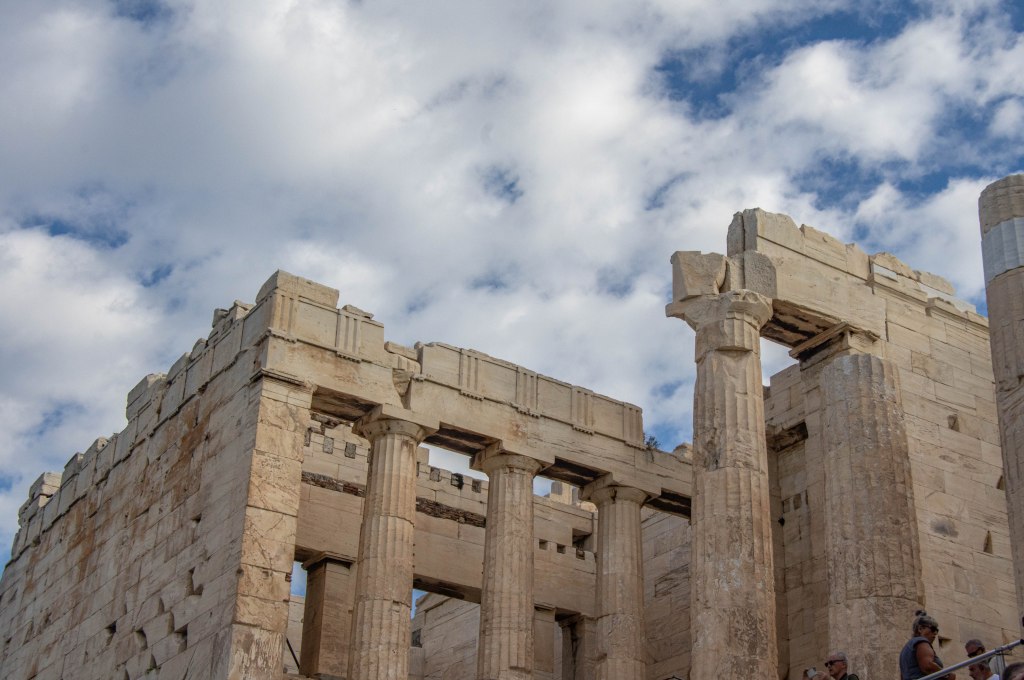
Lastly, Paul calls it “the pillar and foundation of the truth.” This would have been an illustration that the church in Ephesus would have understood. I just returned from a trip to Greece and Italy. I saw the ancient temples in Rome and Athens with their pillars that are still standing. The temple to Diana in Ephesus had 127 pillars. So Timothy could picture what Paul was saying. The church was not only the pillar, it was also the foundation. The foundation is the truth. And what, or should I say, who, is that truth? Jesus says in John 14:6 “I am the way, the truth, and the life. No one comes to the father except through me.” Jesus is that truth that the church is built on.
Let’s look back at that passage in Matthew 16, where the word church is first used. Jesus asks his disciples who people say that he is. They give various answers such as John the Baptist or one of the prophets. But Peter answers correctly. “You are the Messiah, the son of the living God” (vs. 16). Jesus calls him blessed and then changes his name from Simon to Peter and says, “And I also say to you that you are Peter and on this rock I will build my church, and the gates of Hades will not overpower it.” The Catholic Church has taken this to mean that Peter was there anointed to be the first Pope, but is this what Jesus was saying? I don’t think so. This is the first time we see the word church (ekklesia) used in the New Testament and Jesus calls it His. The rock is Jesus. Even Peter refers to Christ as the cornerstone in 1 Peter 2. Peter never holds himself above his peers. He calls himself a “fellow elder” (1 Peter 5:1) and “A servant and apostle of Jesus Christ” (2 Peter 1:1).
The church is the pillar and foundation of truth. These are the parts of a building that provide its support. If the church stops teaching truth it will crumble. Paul knows that many will be deceived and will be warning Timothy of that later in this letter. Warren Wiersbe writes, “The local church is built on Jesus Christ the Truth (John 14:6; 1Cor. 3:9-15); but the local church is also itself a pillar and bulwark for the truth. It is likely that the pillar aspect of the church’s ministry relates primarily to displaying the truth of the word, much as a statue is put on a pedestal so all can see it… The local church puts Jesus Christ on display in the lives of faithful members.”
If you are not part of a good local church, find one! Get involved. Here’s one last passage in case you are not convinced. “And let us consider one another in order to provoke love and good works, not neglecting to gather together, as some are in the habit of doing, but encouraging each other, and all the more as you see the day approaching” (Hebrews 10:24-25).
Grace be with you!
 Abundant Joy