
“Rather, train yourself in godliness. For the training of the body has limited benefit, but godliness is beneficial in every way, since it holds promise for the present life and also for the life to come.”
Paul continues this section by telling Timothy that rather than having anything to do with pointless and silly myths, he should train himself in godliness. This builds on his idea of nourishing himself by the words of faith and good teaching from verse 6.
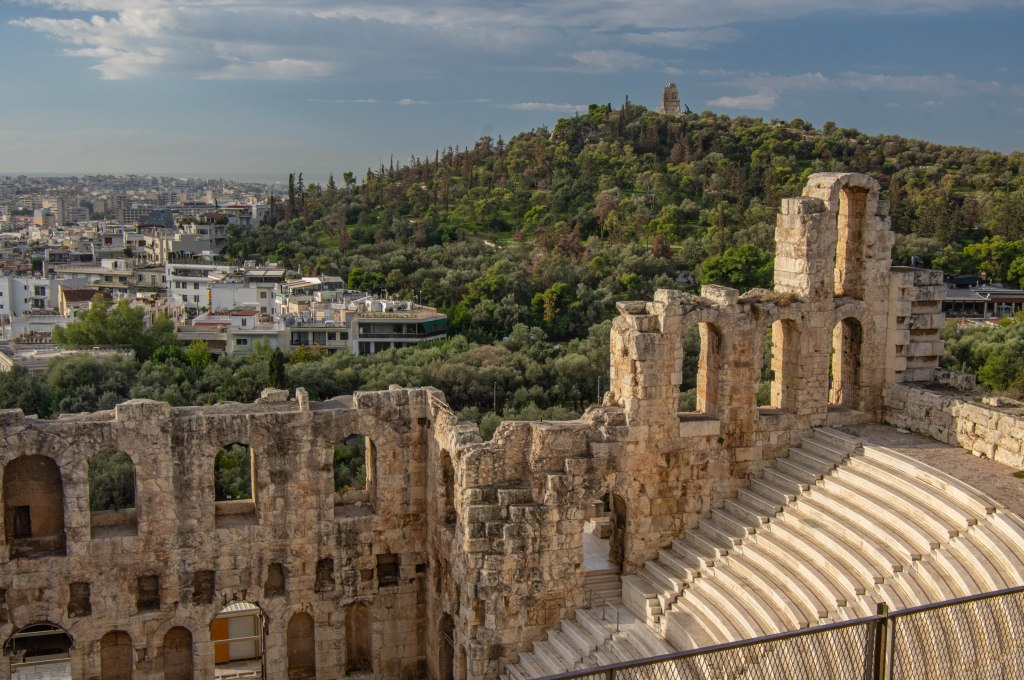
Paul compares training in godliness to training the body. The word training here is ‘gymnasia,’ which means exercise. He uses this analogy several times in his writings. This should not come as a surprise, because competitive games were very popular during Paul’s time. Many Greek and Roman cities possessed theaters and stadiums for this purpose. Let’s look at one of those competitions.
While the Olympics were popular and held every four years during Paul’s lifetime, the Isthmian Games had more of an impact on his writing. These games took place every two years in Corinth during the spring. According to biblearchaeology.org, there are three reasons that Paul would have gone to Corinth on his second missionary journey. First, it was a strategic location for spreading the gospel. Second, there was a Jewish community in Corinth. And third, the Isthmian Games were being held during the spring of AD 51, and many people from throughout Greece came for this. This would give Paul a chance to spread the gospel message. All of these are reasons why Paul would be in Corinth. And the games became an integral part of the analogies in his letters.
What kind of events were there? According to Nelson’s New Illustrated Bible Manners and Customs, “The athletic events included foot races of 200 and 800 yards, races in armor, throwing the discus and javelin, two-horse chariot racing, the Pentathlon (running, jumping, discus and javelin throwing, and wrestling) and the Pankration (a combination of boxing and wrestling).” It was after observing these games that Paul wrote this. “Don’t you know that the runners in a stadium all race, but only one receives the prize? Run in such a way to win the prize. Now everyone who competes exercises self-control in everything. They do it to receive a perishable crown, but we an imperishable crown. So I do not run like one who runs aimlessly or box like one beating the air. Instead, I discipline my body and bring it under strict control, so that after preaching to others, I myself will not be disqualified” (1 Corinthians 9:24-27). His Corinthian readers would have been very aware of the games and the analogies he was using.
As I was looking up the details, Paul probably saw these games in AD 51. He did not write his first letter to Corinth until several years later, but many people date his letter to the Galatians from the year he would have been in Corinth for the games. He uses running and race imagery twice in this letter. First, he writes “I wanted to be sure I was not running, and had not been running, in vain” (2:2) in describing how he had been preaching the message to the Gentiles. Toward the end of that same letter, he laments, “You were running well. Who prevented you from obeying the truth?” (5:7)
We see quite a bit of athletic imagery in his letters to Timothy, and in the letter to the Philippians written the year before, we see two more examples. Paul writes to the church at Philippi that they are to follow Christ’s example, that they are to be blameless and pure, and that they are to be examples to the world around them. He writes that if they do this, “Then I can boast in the day of Christ that I didn’t run or labor for nothing” Philippians 2:16b). In the next chapter he writes that knowing Christ is his ultimate goal and he uses more race imagery. “Brothers and sisters, I do notconsider myself to have taken hold of it. But one thing I do: Forgetting what is behind and reaching forward to what is ahead, I pursue as my goal the prize promised by God’s heavenlycall in Christ Jesus” (3:13-14).
This leads to our verse here in first Timothy. Paul does not say that the training of the body has no benefit, but it has limited benefit-it will only benefit one for this world. The false teachers that he warned Timothy about earlier wanted the believers to deny the body of food and marriage. Remember, the Gnostics taught that the spiritual world was good and the physical world was bad. Paul would not have used all the athletic imagery that he used if he thought it was not good to train the body. But he does use the adjective “limited.” We need to be careful. We should not be Christians who spend more time training our physical bodies and neglecting our spiritual training. In his second letter to Corinth, Paul describes our bodies as clay jars. And then he writes this, one of my favorite passages. “Therefore we do not give up. Even though our outer person is being destroyed, our inner person is being renewed day by day. For our momentary light affliction is producing for us an absolutely incomparable eternal weight of glory. So we do not focus on what is seen, but on what is unseen. For what is seen is temporary, but what is unseen is eternal” (2 Corinthians 4:16-18). Our physical bodies are only temporary, but training in godliness is beneficial both for now and for the life to come.
What does it look like to train yourself in godliness? I love this take from Thomas Hale from The Applied New Testament Commentary. I am going to summarize what he says. He writes that to train means to exercise. The Christian must exercise the mind by reading and knowing God’s Word. He or she must exercise their ears by listening to what the Word of God is saying to them. They must exercise their tongues and lips by praying. They must walk by walking in the ways of God’s Word. The Christian must exercise their joints and limbs by being in service to God. And the Christian must run. They must run the race set before them. I am going to finish with that verse from Hebrews.
“Therefore, since we also have such a large cloud of witnesses surrounding us, let us lay aside every hindrance and the sin that so easily ensnares us. Let us run with endurance the race that lies before us, keeping our eyes on Jesus, the pioneer and perfecterof our faith. For the joy that lay before him, he endured the cross, despising the shame, and sat down at the right hand of the throne of God” (Hebrews 12:1-2).
Grace be with you!
 Abundant Joy